
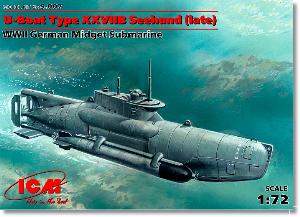
De un vistazo – Quick look
MATERIAL Y PIEZAS
MEDIA & PARTS:
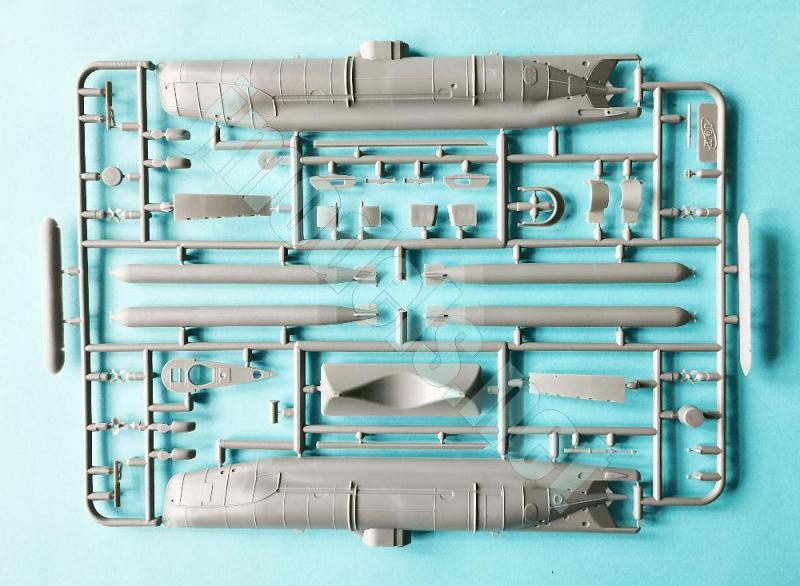
- Plástico inyectado (44 piezas), peana (1 pieza).
- Injected plastic (44 parts), stand (1 part).
CALCAS – DECALS:
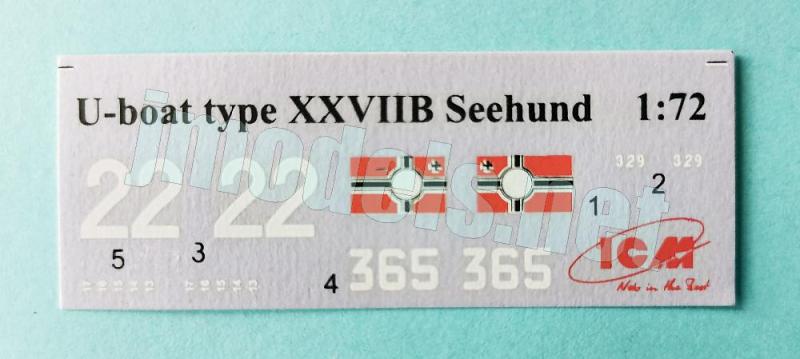
- Bandera sin esvástica, números de gallardete y escala de calado. Apariencia brillante y fina. Buen registro y nitidez salvo la bandera. Sin exceso de soporte.
- Flag without swastika, pennant numbers and draft marks. Thin and glossy finish. Good register and sharpness except the flag. No surplus carrier film.
OPCIONES – OPTIONS:
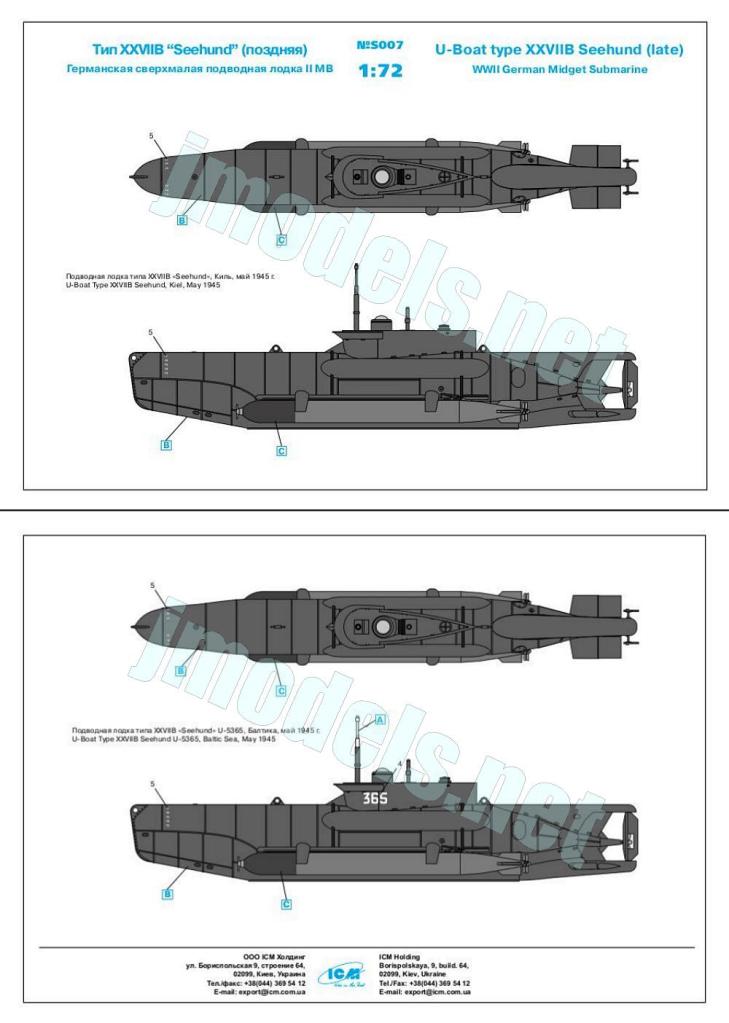
- U-Boot Tipo XXVIIB Seehund. Keil (Alemania). Mayo de 1945.
- U-Boot Tipo XXVIIB Seehund. U-5365. Mar Báltico. Mayo de 1945.
- U-Boat Type XXVIIB Seehund. Kiel (Germany). May 1945.
- U-Boat Type XXVIIB Seehund. U-5365. Baltic Sea. May 1945.
INSTRUCCIONES – INSTRUCTIONS:
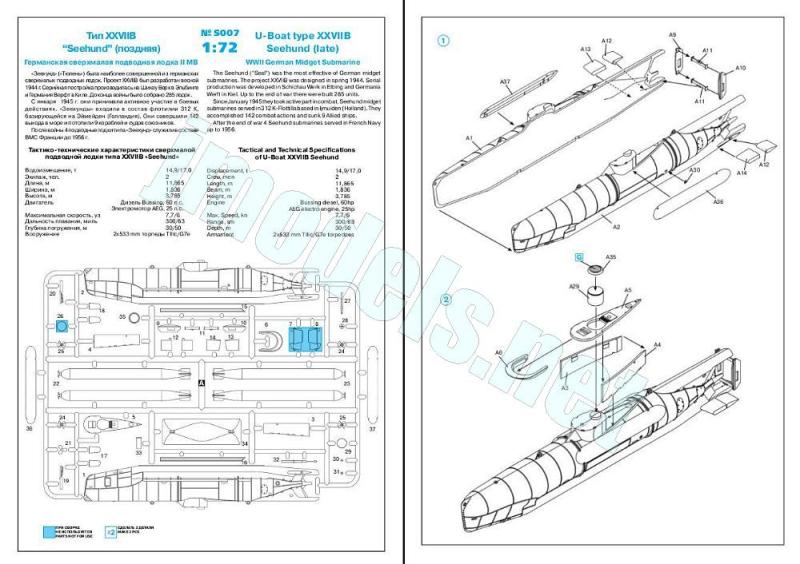
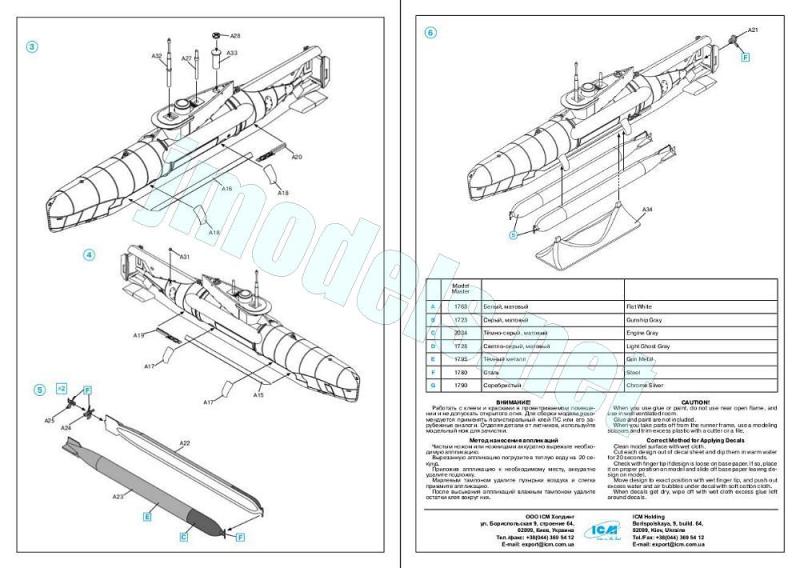
- Folleto en blanco y negro de 4 páginas impreso en blanco y negro. Muestra una introducción histórica con datos técnicos, un plano numerado de piezas, 6 secuencias de construcción y una tabla con códigos y pinturas de Model Master. Una hoja separada de iguales características muestra perfiles de las 2 opciones de pintura.
- 4-page leaflet printed in black and white. It contains a historical introduction with technical data, a numbered parts plan, 6 construction chapters and a chart with Model Master paints and codes. A separate sheet with the same features shows profiles of the 2 paint choices.
LO MEJOR – THE BEST:
- Buen detalle en general. Montaje sencillo.
- Nice overall detail. Ease of assembly.
LO PEOR – THE WORST:
- Cúpula sólida. Algunas piezas muy frágiles.
- Solid dome. Some brittle parts need extra care.
VALORACIÓN – CONCLUSION:
- Requiere un montaje cuidadoso en ciertos momentos, pero es muy apta pera modelistas de distinta experiencia. La cúpula y la peana deberían cambiarse para sacarle más partido a la maqueta.
- It needs careful assembly at certain points, but it’s very suitable for modelers of different experience. The dome and base should be replaced to get the most out of the kit.

La maqueta
Lleva bastante tiempo en el mercado desde que ICM la puso a la venta allá por 2010 junto con la versión inicial del Seehund (referencia S.006). Ambas cajas comparten molde y calcas, por ello es posible construir cualquiera de los cuatro sumergibles que el fabricante incluyó en ellas. La maqueta del modelo inicial también apareció hace algunos años junto con el submarino enano Molch en una caja denominada K-Verbände Midget Submarines (referencia S.020). Revell lanzó una copia del modelo final en 2013.
La caja contiene un único bastidor de piezas, las calcas y las instrucciones. El nivel del modeado es bueno y no se observan deformaciones, rebabas, ni líneas de molde muy visibles. Hay piezas frágiles, como las hélices del submarino y los torpedo, cuya finura ICM ha exprimido a todo lo que el plástico puede dar.
El montaje de esta sencilla maqueta será breve, más aún porque no tiene interior, lo que no significa que no haya que cuidar algunos detalles por el camino. Pintar el modelo tampoco va a ser muy difícil, así que se puede dedicar más tiempo a envejecerlo buscando efectos variados.
Reseña
Los lados del casco muestran tanto líneas grabadas como en relieve, estas últimas parecen querer reproducir líneas de soldadura, que no son muy realistas al tener una textura lisa. Son más evidentes los refuerzos de las tres secciones básicas principales del casco (la proa con los depósitos de combustible en su interior; la sección central, que contiene la cámara de control y las baterías; y la sección de popa, que aloja los motores diésel y eléctrico). También son nítidos los ojales de izado y el de remolque moldeados en los bordes superiores de las mitades. Al pegar las mitades del casco hay que tener cuidado al alinearlas porque no tienen puntos de unión.
El montaje de los elementos del casco empieza con los dos abultamientos laterales y el sistema de propulsión. Este consiste en dos piezas a cada lado para los timones de inmersión, cuya aleta trasera puede colocarse doblada, dos finas aletas verticales unidas por dos travesaños y una hélice con las palas bien definidas y delgadas provista de una tobera.
El siguiente paso es montar la parte posterior de la vela, ya que la zona delantera está unida al casco. Consta de dos piezas laterales y la pequeña cubierta, cuya parte dealntera lleva un deflector de olas separado. Por debajo de la cubierta y a los lados de la vela aparecen aberturas del casco que son demasiado pequeñas y además no son huecas como en el sumergible real.
La cubierta contiene la torre de acceso de los tripulantes, que en este modelo posterior es más alta que en el inicial para dar mayor visión al comandante sobre la superficie. La parte superior de la torre debería llevar una cúpula de plexiglás, pero ICM no se molestó en hacer la pieza transparente y la proporciona de plástico, indicando que se debe pintar de color plateado para simular la transparencia. Sin duda este es lo peor de la maqueta, porque la única manera de sustituirla es haciendo una similar con plástico termoformado. Junto a la torre, también están reproducidos el periscopio, la brújula magnética y el mástil de suministro de aire.
Los torpedos van sujetos al casco mediante dos perfiles y dos soportes laterales a cada lado. Para pegar estos elementos en su lugar exacto es mejor fijarse en fotos de época que seguir las indicaciones no muy precisas de las instrucciones.
Los torpedos están separados en mitades moldeadas con las aletas y las diminutas hélices del detonador, que son bastante delicadas. Las hélices, también muy delgadas y frágiles, vienen separadas. Las superficies de los torpedos están completamente lisas, sin ninguno de los paneles, accesos y otros detalles que se aprecian en fotos. Para colocar los torpedos en sus soportes también es conveniente emplear estas imágenes en lugar de las instrucciones.
La peana de la maqueta es bastante simplona. El modelo mejorará con otra que lo realce más.
La pequeña hoja de calcas contiene una bandera sin la esvástica, números de gallardete y escala de calado. Las calcas, que no tienen soporte sobrante, presentan una apariencia brillante y fina, todas ellas con buen registro y nitidez salvo en la bandera, que no está muy bien reproducida.
El manual de instrucciones está impreso en un folleto en blanco y negro de cuatro páginas que contiene una introducción histórica con datos técnicos, un plano numerado de piezas, seis secuencias de construcción y una tabla con códigos y pinturas de Model Master. El montaje es bastante claro, pero el manual necesita una actualización en lo que concierne a las pinturas para incluir otras gamas de distintos fabricantes. Una hoja separada de iguales características muestra perfiles de las dos opciones de pintura.
La primera de ellas no lleva número de gallardete ni otra identificación. Parece tratarse del conocido Seehund encontrado por los Aliados en el búnker “Konrad” de Kiel en mayo de 1945. De este submarino se conservan varias fotos.
La segunda opción es el U-5365, con número de gallardete 365. ICM sitúa esta unidad en el Mar Báltico en 1945. Sin embargo, el artículo titulado The Pocket U-boat Seehund Part II publicado en la web warhistory.org nos ofrece breves datos sobre su salida de Ijmuiden (Holanda) en febrero de 1945 para operar en el Canal de la Mancha. Sin haber podido encontrar buques enemigos, el submarino embarrancó a su regreso en un lugar de la costa holandesa próximo a la batería artillera alemana de Katwijk, de donde fue remolcado a Scheveningen. Los tripulantes, el Tte. Helmut Hermann y el Obermachinist Hoist lograron salvarse.
Valoración
En general, la maqueta está bien detallada y su construcción es sencilla, por tanto se puede recomendar tanto a iniciados como a neófitos en el tema de los submarinos, aunque haciendo algunas matizaciones.
En la construcción de modelo hay que cuidar la alineación de las mitades del casco y los torpedos así como la manipulación de las hélices por su fragilidad. La peana y especialmente la cúpula sólida deberían sustituirse, pero es bastante más fácil hacerlo en el primer caso que en el segundo.◊

The kit
This Seehund has been on the market for quite some time, since ICM released it back in 2010 along with an early version (reference S.006). Both kits share the same tool and decals, so it’s possible to build any of the four submarines the manufacturer included in the instructions. The early version kit was reboxed a few years ago, along with the midget submarine Molch, in a release called K-Verbände Midget Submarines (reference S.020). Revell also released a copy of the late version in 2013.
The kit contains a single sprue of parts, the decals, and the instructions. The standard of molding is good, and there are no blemishes, flash, or very evident seam lines. There are brittle parts, such as the props of both the submarine and the torpedoes, which ICM made really thin. Assembly of this simple kit will be quick, especially since it has no interior, which doesn’t mean you won’t have to pay attention to some details along the way. Painting the model won’t be too difficult either, so you can spend more time on the weathering work.
Review
The hull halves have both engraved and embossed lines. The raised detail seems to replicate weld lines, which are not very realistic due to their smooth texture. More evident are the reinforcements of the three main hull sections: the bow, containing the fuel tanks; the central section, which houses the controls and batteries; and the stern section with the diesel and electric motors. The lifting and towing eyelets on the hull halves are nicely defined. When mating the hull halves, care is needed to align them, as there are no attachment pins.
Assembly of the hull components begins with the two side bulges and the propulsion system. This consists of two pieces on each side for the diving fin with a rear piece that can be posed deflected, two thin vertical fins joined by two crossbars, and a propeller with well-defined, thin blades and a separate nozzle.
The next step is to assemble the rear sail, as the front section is attached to the hull. It consists of two side pieces and the deck, which has a separate spray-deflecting lip. Below the deck and along the sides of the sail are hull openings that look too small and are not hollow, unlike those in the real submarine.
The deck contains the crew access hatch, which in this late variant is higher than in the early version to give the commander a better view over the surface. The top of the hatch should have a plexiglas dome, but ICM didn’t bother to make the clear piece and provide it in plastic, indicating that it should be painted silver to replicate the glazing. This is clearly the worst thing of the kit, because the only way to replace it is by heat-moulding a replacement. Along with the hatch, the periscope, magnetic compass, and air intake trunk are also reproduced.
The torpedoes are attached to the hull by two profiles and two side supports on each side. To attach these pieces it’s best to refer to period photographs rather than following the somewhat imprecise instructions.
The torpedoes are provided in halves with the fins and the tiny, rather delicate exploder whiskers. The propellers, also very thin and fragile, come separately. The torpedo surfaces are smooth, lacking any of the panels, access hatches, and other details visible in the photographs. It’s also advisable to use these images instead of the instructions to attach the torpedoes.
The stand included in the kit is quite basic and the finished model will benefit from a new one.
The small decal sheet contains a flag without the swastika, pennant numbers, and draft marks. The decals, which have no excess carrier, have a glossy, fine appearance, with good registration and sharpness except for the flag, which is not very well reproduced.
The instruction manual has four pages printed in black and white containing a historical introduction with technical data, a numbered parts diagram, six assembly sequences, and a table with Model Master codes and paints. Assembly steps are quite clear, but the chart should be updated to include paints from different manufacturers. A separate sheet of the same size shows profiles of the two paint options.
The first sub has no pennant number or other identification. It appears to be the well-known Seehund found by the Allies in the «Konrad» bunker in Kiel in May 1945. There are several pictures of this submarine after its capture.
The second option is the U-5365, with pennant number 365. ICM place this unit in the Baltic Sea in 1945. However, the article titled The Pocket U-boat Seehund Part II, published on warhistory.org, provides brief information about its departure from Ijmuiden (Netherlands) in February 1945 to operate in the English Channel. Having failed to locate any enemy ships, the submarine ran aground on its return journey on a stretch of the Dutch coast near the German artillery battery at Katwijk, from where it was towed to Scheveningen. The crew members, Lt. Helmut Hermann and Obermachinist Hoist, survived.
Conclusion
Overall, the kit is well-detailed and easy to build, so it can be recommended to both experts and those new to submarines, although a few caveats are necessary.
When building the model, care must be taken to align the hull halves and torpedoes, as well as to handle the propellers carefully due to their fragility. The base and especially the solid dome should be replaced, but the first will be much easier to get than the second.◊
Publicado – Published: 8 / 2026
©www.jmodels.net


Debe estar conectado para enviar un comentario.