
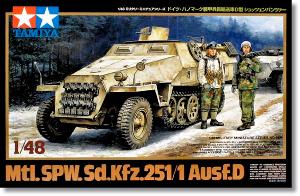
De un vistazo – Quick look
MATERIAL Y PIEZAS
MEDIA & PARTS:
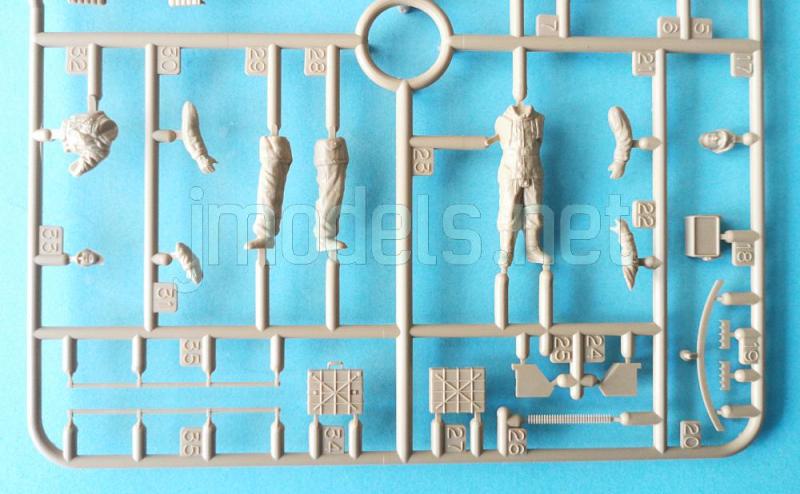
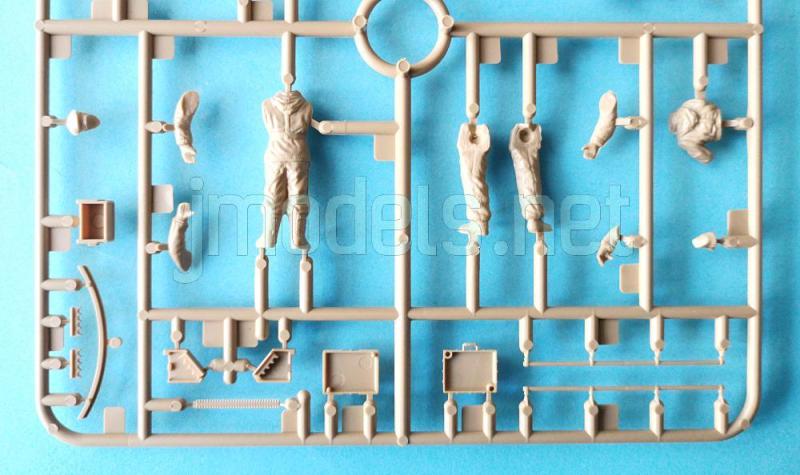
- Plástico inyectado (231 piezas). Incluye 2 figuras (17 piezas).
- Injected plastic (231 parts). Two figures included (17 parts).
CALCAS – DECALS:
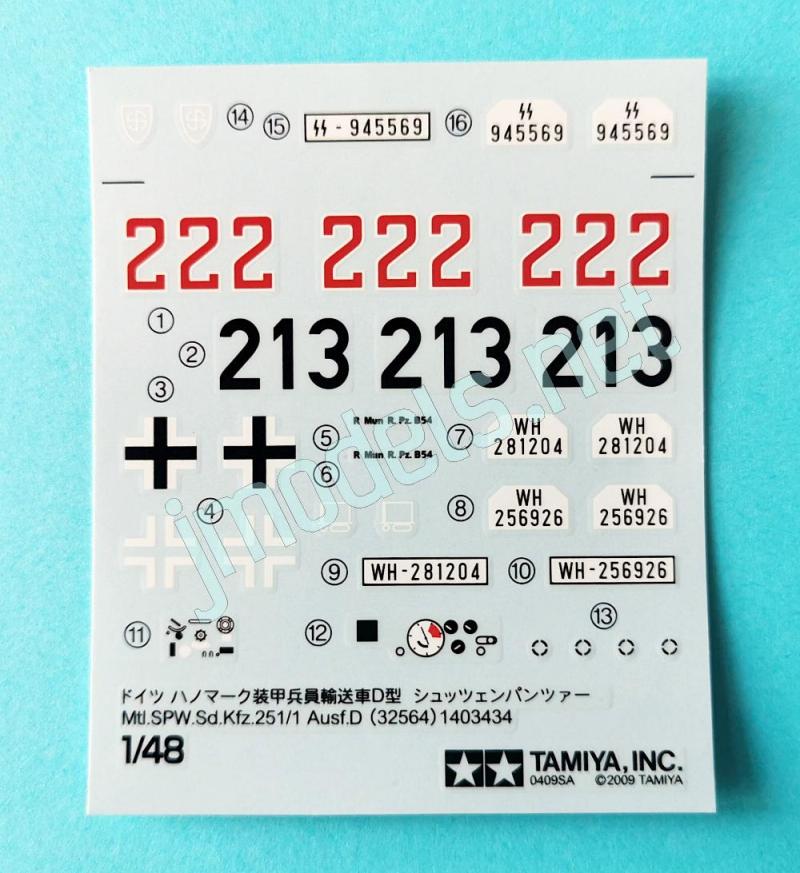
- Cruces alemanas de dos tipos, matrículas, numerales, instrumentos del salpicadero y radio más insignias de unidad. Acabado fino y brillante. Buena saturación de color y nitidez. Mínimo exceso de película soporte.
- Two types of German crosses, plates, vehicle numbers, unit badges, dashboard and radio instruments. Thin and glossy finish. Good color saturation and sharpness. Minimal excess carrier film.
OPCIONES – OPTIONS:
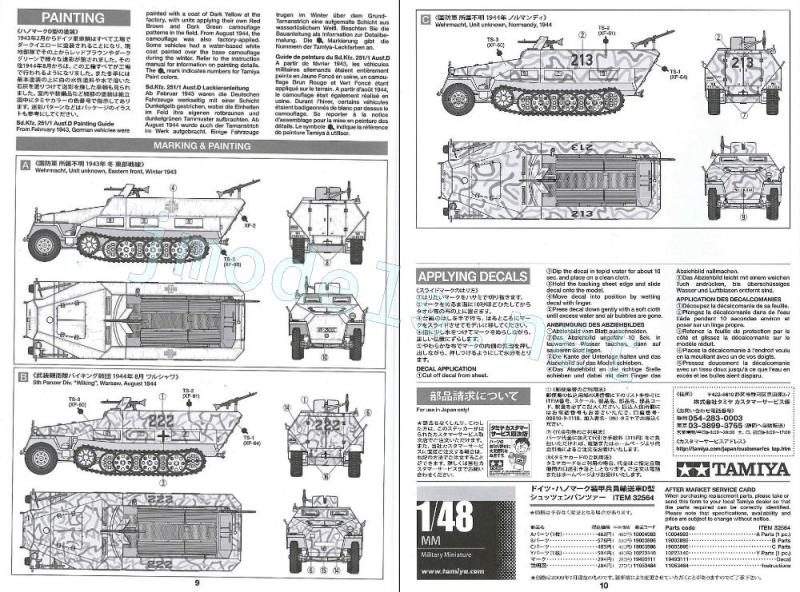
- Sd.Kfz. 251/1 Ausf D. Wehrmacht. Unknown unit. Eastern Front. Winter, 1943.
- Sd.Kfz. 251/1 Ausf D. Waffen SS. 5th SS Panzer Division “Wiking”. Warsaw (Poland). August, 1944.
- Sd.Kfz. 251/1 Ausf D. Wehrmacht. Unknown unit. Normandy, 1944.
INSTRUCCIONES – INSTRUCTIONS:
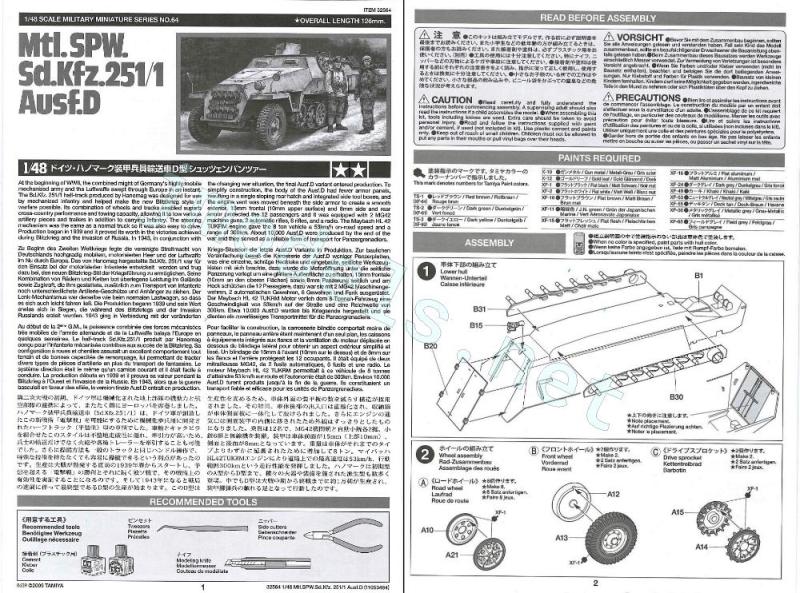
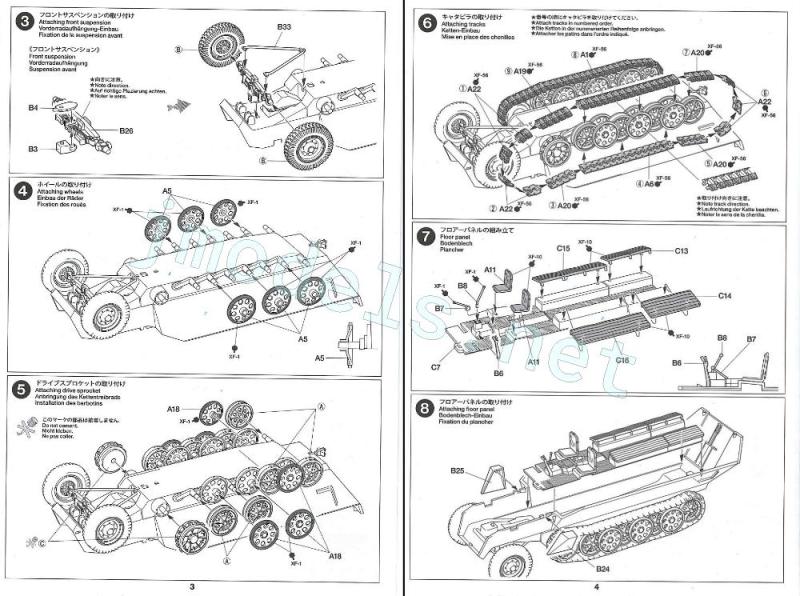
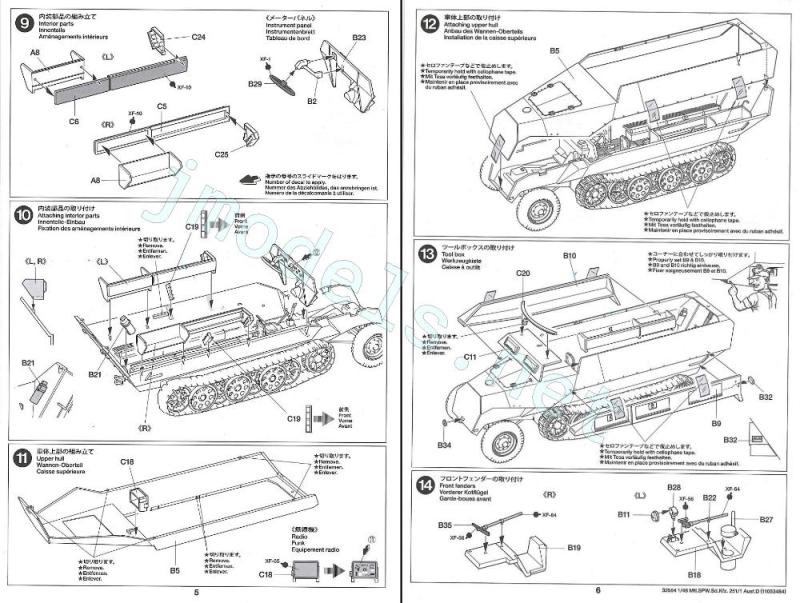
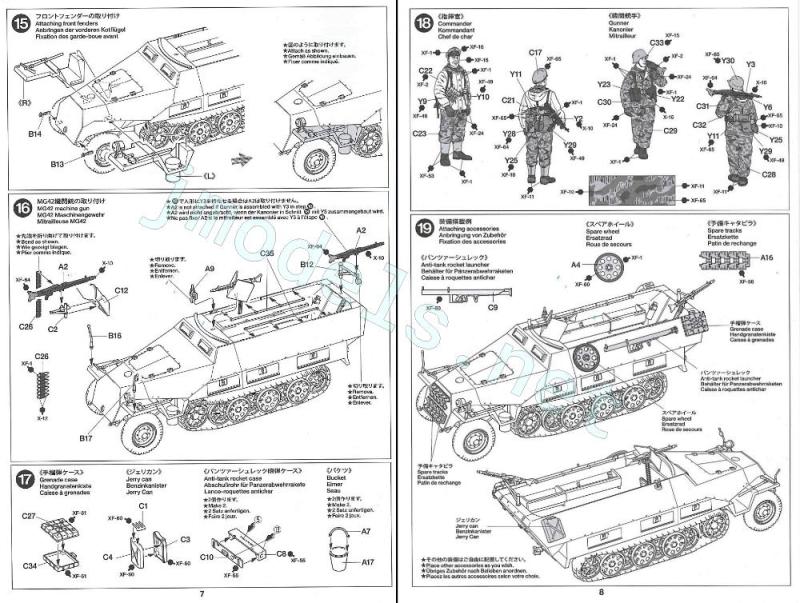
- Folleto doblado de 10 páginas impreso en blanco y negro. Contiene un sumario histórico sobre el vehículo, una lista de pinturas del fabricante, 19 capítulos de montaje y 2 páginas de perfiles.
- 10-page folded leaflet printed in black and white. It contains a historical summary about the vehicle, a list of Tamiya paints, 19 assembly steps and 2 pages of profiles.
LO MEJOR – THE BEST:
- Buen detalle general. Montaje relativamente sencillo. Bastidor extra con armamento y equipo complementario.
- Nicely detailed. Relative ease of assembly. Extra sprue containing infantry weapons and equipment.
LO PEOR – THE WORST:
- Puertas traseras y visores cerrados. Uniforme invernal en las figuras (ver texto).
- Rear doors and visors molded closed. Winter uniforms in the figures (see text).
VALORACIÓN – CONCLUSION:
- Recomendable muy buena edición con buenas figuras, complementos y extras. Tiene pequeños detalles por redondear y necesita cuidado para pegar el casco, pero es apta para la mayoría de modelistas.
- Recommendable nice kit with good figures, complements and extras. It still lacks a few details to round it off and needs some care to build the hull, but is quite suitable for most modelers.

La maqueta
Aunque esta edición es la última de un Ausf. D que tenemos en la escala 1/48, lleva muchos años en el mercado, junto con su secuela Mtl.SPW. Sd.Kfz.251/1 Ausf.D «Stuka zu Fuss» (referencia 32566) que la copia parcialmente. Es un poco raro que Tamiya no haya lanzado hasta ahora otros modelos de este famoso vehículo en la escala 1/48. AFV Club tiene un Ausf. C, al que le dí un repaso en su día (Sd.Kfz. 251/1 Ausf. C Half-Track), y Bandai también tuvo otro C, que hice hace aún más tiempo y me pareció bueno para un molde de los años 70. El fabricante no debería echarlo al olvido.
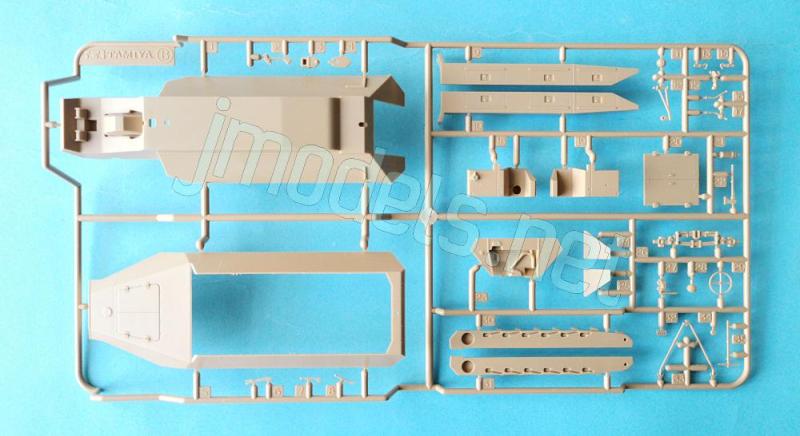
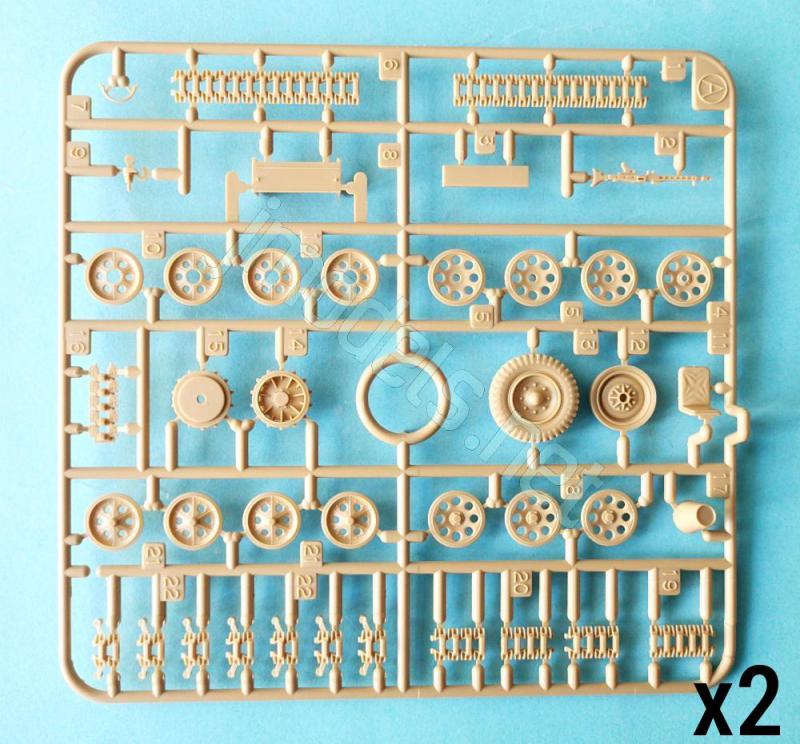
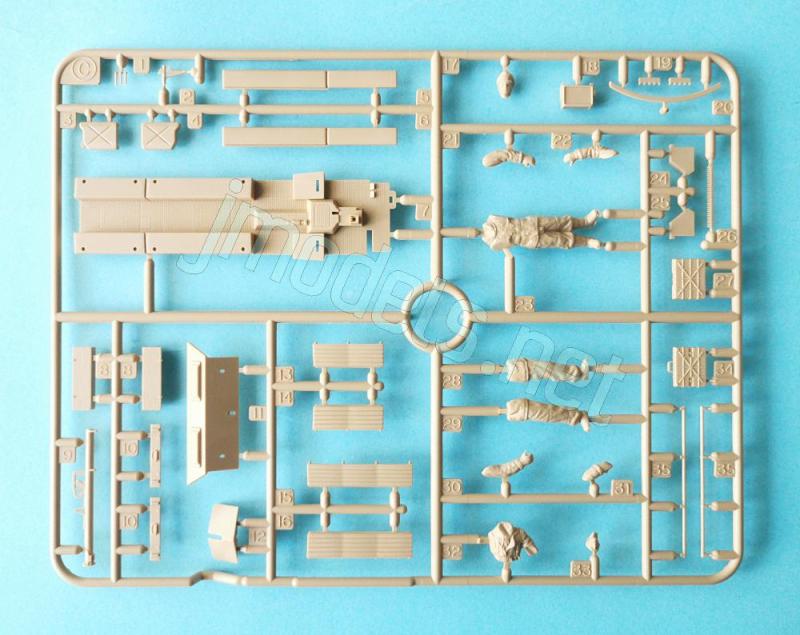
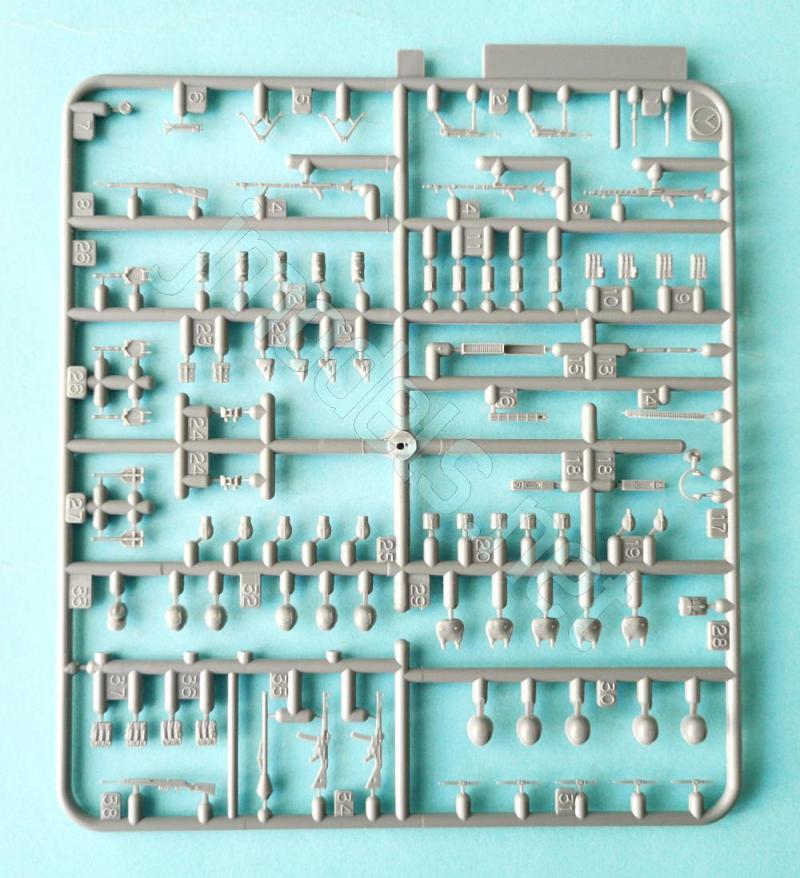
La maqueta comprende la hoja de calcas, las instrucciones, cuatro bastidores, uno de ellos repetido, más otro bastidor extra que contiene una plétora de casi 90 piezas de armamento y equipo alemán, entre ellas cascos, ametralladoras, rifles de asalto, bayonetas, cantimploras, ametralladoras MG 42 y MG 34 y un largo etcétera. Sin duda, todo esto es un buen complemento y aliciente para añadir más figuras alrededor de este semioruga, y en cualquier caso, la caja de restos tampoco se quejará, ya que seguramente tendrán uso oportuno.
Las piezas tienen un moldeado excelente y limpio, con buena nitidez en los detalles. Se aprecian marcas de eyector negativas bajo los guardabarros y el techo del habitáculo del conductor que tal vez no merezca la pena limpiar por no ser visibles, pero no pasa lo mismo con las de los compartimentos de estiba del habitáculo interno. Estas deberían limpiarse a menos que vayamos a colocar algo dentro. Al ser un vehículo abierto, Tamiya ha tenido que emplearse en detallar el interior, pero lo mejor es que también ha incluido algunos elementos para darle más vida al exterior, como un lanzacohetes anticarro y su caja de munición, o un cubo.
En apariencia, el montaje no debe presentar dificultad para el modelista incluso con nivel básico, si se tiene un poco de tino al alinear los paneles blindados laterales. La pintura ofrece un vehículo en camuflaje invernal y dos pintados con culebrillas de tres colores que permiten adornarse con el aerógrafo si se tiene la debida maña. Desgraciadamente, el punto flaco de esta maqueta está en las dos figuras vestidas con uniforme invernal, más apropiadas para usarlas con la versión invernal que con las demás.
Reseña
El casco está dividido en dos mitades. La pieza inferior muestra el motor simulado en la parte delantera y tiene los brazos de la suspensión del tren de rodaje moldeados en dos piezas superpuestas a sus lados inferiores. A esta parte inferior hay que añadir primeramente el gancho de remolque y las puertas de acceso traseras, que cuentan con bisagras bien definidas por fuera y los cierres no tanto por dentro. La pieza superior comprende desde las planchas de protección del motor hasta el blindaje del compartimento trasero.
A cada lado el tren de rodaje lleva ruedas dobles bien moldeadas en piezas separadas con la banda de rodadura de caucho marcada muy fina, la rueda tractora en dos mitades con dientes un tanto pequeños y la ruedas delantera. Esta última tiene la llanta interna independiente, pero buen detalle en los dos lados y sobre el neumático. La banda de rodadura está aceptablemente definida.
El eje delantero es muy sencillo de montar, ya que en su mayor parte está en una pieza con finas barras de torsión añadidas por detrás. El eje muestra buen detalle en la ballesta y las rótulas. Sus extremos tienen pequeños vástagos para fijar las ruedas.
Las cadenas constan de tramos de diferente longitud. Los tramos más cortos, de dos eslabones, presentan la forma adecuada para adaptarlos al contorno de las ruedas. El detalle externo es nítido en las zapatas y enlaces, pero la cara interna sólo muestra los dientes un tanto pequeños.
El montaje pasa a continuación al interior del vehículo. El suelo interno es de una pieza con varios paneles grabados y la textura antideslizante muy fina y bien conseguida para esta escala. La parte delantera tiene la cubierta de la caja de cambios y la transmisión en la pieza. En esta zona solamente hay que añadir los asientos con el respaldo texturizado y las palancas. Los pedales están ausentes. La radio va colocada en la mitad superior del casco y está detallada con una calca. Los bancos traseros se distribuyen en dos piezas desiguales en longitud a cada lado. La simulación del entramado de listones de madera es mejor en el exterior que por el lado opuesto, aunque este no se va a apreciar.
En una segunda fase del montaje del interior se añade el panel delantero del motor, que cuenta con la columna de dirección y un fino volante aparte. Los diales e instrumentos son de calca. En la parte posterior hay que situar un extintor, los compartimentos de estiba y del armamento, más los respaldos de los asientos pegados sobre ellos. El del armamento tiene a los lados dos piezas con estantes para colocar los fusiles. El de estiba tiene un par de marcas internas leves que conviene limpiar.
Procede ahora la parte más delicada del montaje, que es alinear correctamente las dos mitades del casco antes de pegarlas definitivamente. Tras esto, se añaden las dos planchas inferiores de los lados, que están grabadas con las cajas de respeto y sus cierres. Una de ellas está detallada en la parte trasera con las luces de convoy. También aquí hay que cuidar la alineación de las piezas.
La plancha frontal del conductor viene unida al techo del compartimento. Los visores frontales están moldeados cerrados, lo que resta al modelista la posibilidad de colocarlos abiertos para mayor realismo, lo mismo que sucede con las puertas traseras y las de acceso al motor sobre el capó. Los guardabarros están detallados con finas herramientas (pala y hacha), el faro de conducción nocturna, los indicadores de gálibo y el tubo de escape. Tambien hay dos pequeños enganches bajo la plancha delantera del vehículo.
En la fase final del montaje sólo resta colocar el armamento, la base de la antena en el lado derecho del casco y el equipo estibado por fuera. El escudo y el afuste de la ametralladora frontal son lo bastante delgados. Las MG 42 también son destacable por su nítido aspecto y la de proa lleva además una cinta de munición para darle más detalle. El arma trasera tiene el soporte muy fino por separado. Las instrucciones indican que esta no se coloca en el vehículo si la vamos a emplear con una de las figuras, pero lo cierto es que tenemos otra pieza similar en el bastidor extra.
Parte del equipo externo lo podemos situar a voluntad. Está compuesto por un Panzerschreck (Raketenpanzerbüchse 54) con su caja de munición, una caja de granadas, dos tramos de cadena sobre el frontal del motor, dos cubos, una rueda de repuesto y un contenedor de combustible. No es poco.
Las figuras incluidas en esta edición están pensadas para ambientar el vehículo en una escena invernal y no tanto de verano. Representan a un oficial con gorra de visera más un soldado con casco y una MG 42 al hombro, ambos en pie. En mi opinión, tienen suficiente definición en las prendas y el equipo.
El oficial tiene separados la cabeza, el torso, los brazos y las piernas unidas a las caderas. Viste un uniforme de pantalones camuflados y una parca invernal blanca con capucha bien definida. Lleva polainas en las botas y porta una MP40, cantimplora, funda de máscara antigás, bolsa de pan, cananas de cargadores de ametralladora y una funda portamapas.
El soldado tiene el mismo despiece, salvo el casco separado de la cabeza y medio brazo unido al torso. El uniforme es idéntico, pero la parca con capucha está vuelta por su lado camuflado. El patrón del camuflaje lo muestran las instrucciones en una vista a buen tamaño. En lugar de con la MG 42, podemos emplear una de las MG 34 o un Panzerfaust del bastidor suplementario, por ejemplo.
Las figuras están condicionadas por su uniforme a que las empleemos con un vehículo pintado en camuflaje invernal. Si deseamos ambientar cualquiera de las otras dos alternativas de la caja, hay que buscar otras figuras.
La hoja de calcas lleva impresas cruces alemanas de dos tipos, matrículas, numerales, instrumentos del salpicadero y la radio, además de insignias de unidad con un acabado fino y brillante, buena saturación de color y nitidez. El exceso de película soporte es mínimo.
El folleto doblado de las instrucciones consta de diez páginas impresas en blanco y negro. Contiene un sumario histórico sobre el vehículo, una lista de pinturas de Tamiya, 19 capítulos de montaje y dos páginas de perfiles. Los acabados permiten pintar un vehículo con camuflaje invernal y dos similares con camuflaje disruptivo de tres colores compuesto de líneas empleado al final de la Guerra Mundial.
Valoración
Al igual que otras maquetas militares en la escala 1/48, esta edición tiene un buen detalle en general y está diseñada para montarla sin dificultad y rapidez, aunque en este caso hay que tener más tiento con la alineación del casco. Tratándose de un vehículo abierto, el proceso de pintura no es tan contínuo, ya que hay que dedicarle su tiempo al interior. La inclusión del bastidor adicional de equipo y armamento es un acierto y otro incentivo para ambientarlo con más figuras.
A mi juicio, para haberla redondeado sin esfuerzo a Tamiya le han faltado pocos detalles, como los visores y puertas, además de haber salvado el condicionante del uniforme invernal de las figuras, pero ya se sabe que el mejor escriba echa siempre algún borrón.◊

The kit
This is the latest Ausf. D we have in the 1/48 scale, but it has been around for many years, along with its sequel, Mtl.SPW. Sd.Kfz.251/1 Ausf.D «Stuka zu Fuss» (reference 32566), which is partially the same kit. It’s a bit strange that Tamiya haven’t released other variants of this famous vehicle in this scale so far. AFV Club have an Ausf. C, which I reviewed some time ago (Sd.Kfz. 251/1 Ausf. C Half-Track), and Bandai also had another C a long while ago, which I built once and thought was good for a 1970s kit. Perhaps the manufacturer shouldn’t let it fall into oblivion.
The kit includes a decal sheet, the instructions, four sprues (one of them doubled), plus an extra sprue with a plethora of nearly 90 pieces of German infantry weapons and equipment, including helmets, machine guns, assault rifles, bayonets, canteens, MG 42 and MG 34 machine guns, and much more. All of this is a great complement and incentive to add more figures around this half-track, and in any case, they come in handy, as they will surely find a future use.
Parts have an excellent and clean molding, with good sharpness in detail. Negative ejector marks are visible under the fenders and the roof of the driver’s compartment. Perhaps they aren’t worth cleaning as they are not evident, but the same cannot be said for those in the stowage bins inside the hull. These should be cleaned unless you plan to put something inside them. Being an open vehicle, Tamiya has had to add some work in the interior, but the best part is that they have also included some elements to enhance the exterior, such as an anti-tank rocket launcher, an ammo box, or a bucket.
At first glance, assembly shouldn’t have any difficulty for even a beginner modeler, provided he is careful when aligning the hull pieces. Paint choices cater for one vehicle in winter camouflage and two painted with three-color squiggles, which can look fine if you’re skilled enough with an airbrush. Unfortunately, the drawback of this kit lies in the two figures dressed in winter uniforms, more suitable for use with the winter version than the others.
Review
The hull is divided into two halves. The lower piece shows the simulated engine at the front and has the suspension arms molded in two overlapping pieces on the lower sides. The pintle hook and rear doors, molded with sharp hinges on the outside but less defined latches on the inside are attached to this lower hull in the first building steps. The upper piece is molded with the hood and the hull upper plates.
On each side the running gear features separate double road wheels with very finely engraved rubber treads. The sprockets come in two halves with a bit small teeth, and the front wheel has a separate inner rim, with good detail on both sides and the tire. The tread pattern is acceptably defined.
The front axle is very easy to assemble as it is mostly a single piece with thin torsion bars added behind. The axle shows good detail in the leaf spring and ball joints. The tips have small pins for attaching the wheels.
The tracks come in different sections. The shorter two-link lengths are shaped to fit the contours of the wheels. External detail is sharp on the rubber pads and links, but the inner surface is flat and only shows small teeth.
Assembly then moves to the interior of the vehicle. The floor is a single piece with several engraved panels and a nice anti-slip texture. The front has the gearbox cover and transmission molded in the piece. Here, only the seats with textured backrests and the levers need to be added. The pedals are missing. The radio is attached to the upper hull half and is detailed with a decal. The rear benches are provided in two pieces on each side. The rendition of the wooden slats is much better on the exterior than on the opposite side, although this difference will not be noticeable.
The second phase of the interior assembly starts attaching the front engine bulkhead, the steering column and a separate, thin steering wheel. The dials and instruments are decals. The rear compartment is detailed with a fire extinguisher, the stowage bins, and the seat backs attached to them. The storage compartments has two pieces on either side with shelves for rifles. They have a couple of light internal marks that should be cleaned.
Now comes the most delicate part of the assembly, which is aligning the two hull halves correctly before gluing them together. After this, the two lower side panels are added, which are engraved with the stowage bins and the latches. One of the panels is detailed with the rear Notek tail lights. Here, too, careful alignment of the pieces is essential.
The hull front plate is molded with the roof of the driving compartment. The engine access covers and front visors are molded closed, these the modeler from positioning them open for greater realism, as is the case with the rear doors. The fenders are detailed with fine tools (shovel and axe), the night driving light, the width indicators, and the exhaust pipe. There are also two small tow hooks under the front engine plate of the vehicle.
In the final stage of assembly, you add the armament, the antenna base, and the equipment carried outside the hull. The shield and the front machine gun mount are quite thin. The MG 42s are also very nice and crisply molded, and the front one even has an ammo belt for added detail. The rear gun also has a separate, very thin mount. According to the instructions, this piece is not placed on the vehicle if it’s used with the soldier figure, but in fact, there’s another similar part in the extra sprue.
Some of the external equipment can be attached as desired. It consists of a Panzerschreck (Raketenpanzerbüchse 54) with the ammo box, a grenade box, two lengths of track on the front engine plate, two buckets, a spare road wheel, and a jerrycan. That’s quite a lot.
The figures included in this box are designed to set the vehicle in a winter rather than a summer scene. They represent an officer with a peaked cap and a soldier with a helmet and an MG 42 held over his shoulder. Both the uniforms and equipment are well detailed.
The officer’s head, torso, arms, and legs/hips are separate. He wears camouflage trousers and a white winter parka with a well-defined hood. He has gaiters on his boots and carries an MP40, canteen, gas mask case, bread bag, machine gun magazine pouches, and a map case.
The soldier has the same parts breakdown, except the separate helmet and half an arm attached to the torso. The uniform is identical, but the hooded parka is turned inside out with the camouflage side facing out. Instead of the MG 42, we can use, for example, one of the MG 34s or a Panzerfaust from the extra sprue, for example. The figures’ uniforms are restricted to use with a vehicle painted in winter camouflage. If we wish to use either of the other two choices in the box, we need other figures.
The decal sheet shows two types of German crosses, license plates, vehicle numbers, dashboard and radio instruments, as well as unit badges, all with a fine, glossy finish, good color saturation, and sharpness. Excess carrier is minimal.
The folded instruction booklet consists of ten pages printed in black and white. It contains a historical summary of the vehicle, a list of Tamiya paints, 19 assembly chapters, and two pages of profiles. You have a choice for a vehicle in winter camouflage and two vehicles painted in the three-color disruptive camouflage pattern used at the end of World War II.
Conclusion
Like other 1/48 military kits Tamiya have released, this is generally well-detailed and designed for quick and easy assembly, but in this case, you need to be more careful with the hull alignment. Being an open-top vehicle, the painting process isn’t as straightforward, as you need to dedicate some time to the interior. The inclusion of the equipment and weapons sprue is a welcome addition and another incentive to display the half-track with more figures around.
Tamiya only missed a few details to round this kit off, such as the visors, doors and the figures’ winter uniform. But, as they say, even Homer sometimes nods.◊
Publicado – Published: 7 / 2026
©www.jmodels.net


Debe estar conectado para enviar un comentario.