
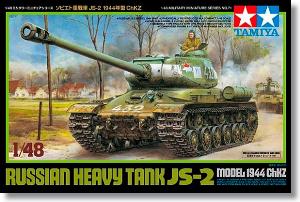
De un vistazo – Quick look
MATERIAL Y PIEZAS
MEDIA & PARTS:
- Plástico inyectado (197 piezas), hilo trenzado (1 tramo), rodamientos de plástico (4 piezas), cilindros metálicos (4 piezas). Incluye una figura (4 piezas).
- Injected plastic (197 parts), thread (1 length), plastic poly caps (4 parts), metal cylinders (4 parts). One figure included (4 parts).
CALCAS – DECALS:
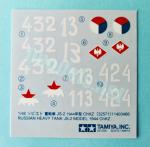
- Insignias rusas, checoslovacas y polacas, numerales. Finas y brillantes, con buena saturación de color y sin soporte excesivo.
- Russian, Czechoslovak and Polish markings, numbers. Thin and glossy appearance, with good color saturation and not too much carrier film.
OPCIONES – OPTIONS:
- JS-2. 7ª Brigada Independiente de Carros Pesados de la Guardia. Berlín, abril de 1945.
- JS-2. 8ª Regimiento Independiente de Carros Pesados de la Guardia. Berlín, abril de 1945.
- JS-2. 1ª Brigada de Carros Checoslovaca. Praga, mayo de 1945.
- JS-2. 4º Regimiento de Carros Pesados Polaco. Alemania, abril de 1945.
- JS-2. 7th Independent Guards Heavy Tank Brigade. Berlin, April 1945.
- JS-2. 8th Independent Guards Heavy Tank Brigade. Berlin, April 1945.
- JS-2. Czechoslovak 1st Tank Brigade. Prague, May 1945.
- JS-2. Polish 4th Heavy Tank Regiment. Germany, April 1945.
INSTRUCCIONES – INSTRUCTIONS:
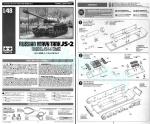
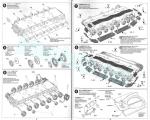
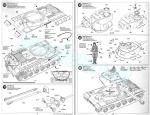
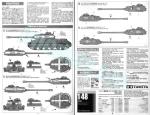
- Folleto doblado de 8 páginas impreso en blanco y negro. Contiene una lista de pinturas, 14 secuencias de montaje y perfiles. Una hoja doblada adicional impresa en blanco y negro en dos caras muestra un resumen histórico y especificaciones del vehículo en varios idiomas.
- 8-page folded leaflet printed in black and white. It contains a list of paints, 14 assembly steps and profiles. A separate folded sheet printed in black and white shows a historical summary with specifications of the vehicle in several languages.
LO MEJOR – THE BEST:
- Excelente detalle general. Fácil montaje.
- Excellent overall detail. Easy build.
LO PEOR – THE WORST:
- Marcas de eyector (aunque pequeñas y leves). Rejillas laterales de la cubierta del motor.
- Pin marks (though small and shallow). Engine deck side grilles.
VALORACIÓN – CONCLUSION:
- Tamiya sigue dando en el clavo con esta maqueta bien detallada y sencilla de armar. Tiene algunos detalles menos acertados, que no impiden a los menos diestros lograr un modelo decente de caja.
- Tamiya hits tha nail again with this kit, nicely detailed and easy to build. It has its downsides that will not prevent the less experienced to finish an attractive model out of the box.

La maqueta
En su día, la edición de Tamiya vino a cubrir el hueco que el carro pesado JS-2 tenía en la escala 1/48, donde la única opción era la maqueta de resina de la marca Gaso.line. Tamiya ya poseía este carro en la escala 1/35, de modo que en la nueva maqueta tiró del grande para hacer el pequeño. El despiece de ambos es muy parejo, las versiones de pintura son las mismas y hasta la caja es idéntica, salvando el fondo.
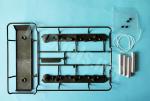
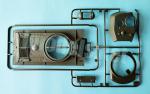
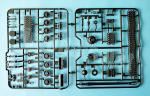
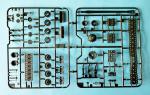
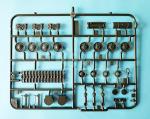
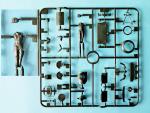
La caja contiene siete bastidores, un tramo de hilo trenzado, cuatro rodamientos de plástico y cuatro cilindros de metal para simular el peso del vehículo. El moldeado de las piezas es de gran calidad y no presenta rebabas ni deformaciones. Hay leves marcas de eyector en la cara interna de las tapas de las escotillas, a los lados del casco próximas a las ruedas tractoras y también en las cadenas. Estas últimas podrán disimularse relativamente con la pintura y el desgaste adecuado.
El número de piezas es un tanto elevado comparado con otras maquetas del fabricante a esta escala, incluso descontando las alrededor de 22 elementos que quedarán sin emplear. Sin embargo, todo indica que el montaje no va a ser nada difícil, como de costumbre.
La maqueta representa un IS-122 (designación real del denominado IS-2) de 1944 con el frontal del casco de fundición mostrando diferencias en el glacis y en el diseño del periscopio del conductor entre otras. Este modelo, aunque tardío, aún no llevaba la ametralladora en la cúpula ni los depósitos auxiliares en la parte trasera.
Parte inferior del casco
La parte inferior del casco está formada por cuatro piezas. El lado trasero está moldeado con el fondo, pero la plancha tiene otra sobrepuesta. Dentro del casco tenemos cuatro cilindros metálicos para simular el peso del vehículo pegados al suelo.
Los lados anterior y posterior llevan enganches de remolque y eslabones de las cadenas moldeados con los soportes. Los lados muestran paneles de acceso, las cubiertas de los diferenciales traseros unidos a los ejes de las ruedas, las cubiertas de los rodillos de retorno y los topes de los brazos de la suspensión. Las superficies carecen de la textura de fundición que sí tienen otras zonas del casco y la torre. Extrañamente, Tamiya ha dejado varias marcas pequeñas y poco profundas junto a las ruedas tractoras que deberán taparse.
Suspensión y cadenas
Los brazos de la suspensión están moldeados con limpieza. La base de cada uno tiene un pequeño vástago insertado en el casco que permite pegar todos los brazos a la misma altura y así lograr que el modelo quede nivelado. Las ruedas tensoras llevan sus ejes separados.
Todas las ruedas son dobles, incluidos los rodillos de retorno. El refuerzo de fundición radial está bien representado, así como la cubierta central. El buje de las ruedas de apoyo tiene los cinco agujeros característicos y tres en los rodillos.
La tractoras tienen la cubierta del buje separada y un rodamiento entre las dos mitades que no debemos pegar para permitir que giren, maniobra necesaria al montar las cadenas. El detalle de estas ruedas también es muy bueno, con los dientes bien definidos y las tres coronas de pernos finamente reproducidas. El mecanismo para limpiar las ruedas tractoras viene separado. Es conveniente considerar que una vez pegado, la rueda tractora no se puede sacar de su eje si necesitamos hacerlo, por ello es mejor añadirlo tras montar las cadenas.
Las cadenas están separadas en tramos y eslabones. El tramo superior ya viene moldeado simulando la caída de los eslabones entre los rodillos, por lo que debemos suponer que vamos a montar un carro sin movimiento. Los eslabones poseen nitidez en el detalle, que es notable en las cabezas de los pasadores. El lado externo muestra con claridad los huecos de los dientes moldeados en la otra cara con idéntica buena definición. Desgraciadamente, las caras internas muestran ligeras marcas próximas a la parte central de algunos eslabones. Esto permitirá disimular parte de ellas al situar las ruedas encima, pero no todas.
El montaje de las cadenas sigue un orden preestablecido en las instrucciones y comienza por el tramo superior, sigue por la rueda tractora, la tensora y, finalmente, el tramo inferior. Ya que la maqueta no incluye la plantilla para montar las cadenas de su hermana mayor, parece conveniente seguir el orden que se sugiere.
Superestructura
La parte superior del casco viene de una pieza unida a los guardabarros, que sólo tienen la parte delantera separada. En general, el detalle de los accesos al motor es bastante bueno y la finura de los guardabarros, que tienen los extremos biselados, me parece adecuada para esta escala. Sin embargo, las rejillas de ventilación y escape flojean bastante. No están mal representadas, pero las persianas de ventilación del radiador no vienen abiertas y la malla de las rejillas del motor no logra la definición de un fotograbado.
En lo relativo a la reproducción de la textura de fundición, da la sensación que Tamiya ha preferido quedarse corto que pasarse. El glacis y la parte central del casco hasta justo detrás del hueco de la torre muestra una textura irregular muy leve y el visor del conductor, que tiene una pieza añadida por dentro, carece de las evidentes soldaduras de fundición a los lados. En cualquier caso, Tamiya parece querer contentar tanto al modelista novato como al veterano, que siempre podrá acentuar el detalle con la socorrida masilla diluida.
La parte frontal del casco lleva un faro y una bocina que pueden situarse opcionalmente en el lado derecho o izquierdo. Desafortunadamente, el faro no tiene lente transparente. Sobre un guardabarros hay un par de grilletes de remolque. Los lados están detallados con herramientas (sierra y pala) y cajas de respeto separadas, además de los depósitos auxiliares, moldeados con las correas y los lados aparte. En la parte posterior hay que añadir el hilo del cable de remolque con los ojales de plástico y sus pequeños enganches. El tramo de hilo no aporta nada al detalle y merece un reemplazo. También hay que añadir el retén de transporte del cañón de una sola pieza.
Torre
El despiece de la torre comprende dos piezas seccionadas coincidiendo con el borde de la línea de soldadura; una parte superior con el techo y la otra conteniendo la base con el anillo. Los lados están ligeramente texturizados para representar las superficies fundidas, mientras que el techo es liso. El mantelete junto con la plancha de protección superior, que muestra algunas bisagras en la pieza, vienen aparte.
El techo tiene los periscopios y la toma de ventilación ahuecados. La base de la cúpula del comandante también tiene los periscopios horadados y se detalla con el anillo y las tapas, que pueden ponerse abiertas. Una de las tapas lleva también el periscopio hueco pero sin detalle interno. La tapa de la escotilla del artillero está separada, pero no puede colocarse abierta al estar moldeada con el anillo y la bisagra en posición cerrada.
Los lados de la torre tienen varias asas finas en el contorno, los ganchos de izado y la ametralladora trasera con su afuste separado.
El cañón está separado en mitades e insertado en su base, que muestra los agujeros de las miras. Una pieza interna sujeta por dos muñones y dos rodamientos permiten mover el arma una vez pegada al mantelete. Esta pieza tiene abierto el evidente hueco lateral de forma ovalada.
Figura
Tamiya proporciona la figura del comandante, idéntica a la de su maqueta a escala 1/35, que va pegada sobre un soporte moldeado en el anillo interno de la torre. Tiene los brazos y la cabeza separados y muestra una pose relajada, apoyado en la escotilla, en consonancia con el vehículo detenido.
La cabeza tiene los rasgos faciales medianamente perfilados y está tocada con casco de carrista. Los detalles del uniforme me parecen buenos, especialmente la definición de las botas y las arrugas del atuendo.
Calcas
La hoja contiene numerales, insignias rusas, checoslovacas y polacas. Las calcas son finas y brillantes, con buena saturación de color y no presentan soporte excesivo.
Instrucciones
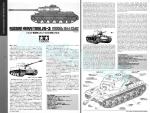
Se proporcionan en un folleto doblado de ocho páginas impreso en blanco y negro que muestra una lista de pinturas de Tamiya, 14 secuencias de montaje y perfiles. Una hoja doblada adicional impresa en blanco y negro en dos caras muestra un resumen histórico y especificaciones del vehículo en varios idiomas. Tanto los pasos del montaje como las indicaciones adicionales son muy claros.
Los carros de los perfiles tienen el mismo acabado salvo en las marcas nacionales y las marcas de reconocimiento de la torre en las opciones rusas. Estas marcas hay pintarlas y tal vez lo ideal sea hacerlo a mano para darles más realismo.
Valoración
Tamiya vuelve a dar en el clavo en esta maqueta de sencillo montaje y notable detalle, que se adapta sin dificultad tanto al modelista menos avanzado, que pueden montarla de caja, como a los experimentados, que tienen margen para mejorar ciertos detalles, como la textura de fundición, las rejillas del motor y acaso un cañón de aluminio.◊

The kit
In its day, this kit arrived to fill the gap the JS-2 heavy tank had in the 1/48 scale. Until then the only choice was the resin kit from Gaso.line. Tamiya already had this tank in the 1/35 scale, so they used it to produce its small counterpart. Both releases are very similar, the paint versions are the same and even the artbox is identical except for the background.
The box contains seven sprues, a length of twine, four plastic poly caps and four metal cylinders to simulate the weight of the vehicle. The standard of moulding is quite good and parts do not have flash or blemishes. There are shallow pin marks on the inner hatch covers, on the hull sides next to the sprockets and also on the tracks. These can be relatively hidden with paint and appropriate wearthering.
Parts count number is a bit high compared to other 1/48 kits from the manufacturer, even if we leave out the 22 or so pieces that will not be used. However, everything indicates that assembly will not be difficult at all, as usual.
The kit represents an IS-122 (real designation of the so-called IS-2) from 1944 with the front of the cast hull showing differences in the glacis and in the design of the driver’s periscope among others. This model, although late, did not still have the cupola machine gun or the two auxiliary tanks in the rear.
Lower hull
The hull bottom is made up of four pieces. The rear side is moulded with the bottom, but it has another plate overlapped. Inside the hull are four metal cylinders to simulate the weight of the vehicle attached to the floor.
The front and rear sides show towing hooks and spare track links moulded with the brackets. The sides include the access panels, rear differential covers attached to the wheel axles, the return roller axles and the suspension bumpers. Surfaces lack the cast texture found on the hull and turret. Oddly, Tamiya has left several small, shallow marks next to the sprockets that will need to be covered.
Suspension and tracks
The separate suspension arms are cleanly moulded. The base of each piece has a small pin to insert into the hull which allows all the arms to be glued level to keep the finished model even. The idler wheels have separate axles.
All the wheels are two-piece, including the return rollers. The radial cast reinforcement is well represented, as is the centre hubcap. The roadwheels show the characteristic five holes and the rollers have the correct three in each piece.
The sprockets have a separate hubcap and a poly cap in between the two wheel pieces which are not glued to allow them to rotate. This will be useful later to install the tracks around the sprockets. Detail on these wheels is also very good, including sharp teeth and the three crowns of nuts finely reproduced. The mud cleaning device comes separately. Once this piece is attached, the sprocket cannot be taken off the axle if we need to do so, for this reason it seems best to add it after assembling the tracks.
The tracks are separated into lengths and links. The upper section is already moulded to simulate the sag between the rollers, so we should assume that we are building a stationary tank. The links have a sharp detail, which is nice on the pin heads. The outer side clearly shows the gaps of the teeth moulded on the other side with the same good definition. Unfortunately, the inner sides show slight marks on some links. Some will still be hidden when placing the wheels on the links, but not most of them.
Track assembly follows a pre-established order in the instructions and begins with the upper length, followed by the drive wheel, the idler and, finally, the lower length. Since the kit does not include the jig provided in its 1/35 brother, it seems practical to follow the suggested order to make things easier.
Superstructure
The upper hull is one piece joined to the fenders, which only have the front section separated. Detail on the engine hatches is quite good and the fenders look thin for the size and have bevelled ends. However, the intake louvers and exhaust grilles are quite weak. They are not badly represented, but the radiator intake louvers are not open and the plastic mesh on the engine grilles cannot beat the definition of a photo-etched part.
Regarding the reproduction of the cast texture, it seems that Tamiya has preferred to fall short rather than go overboard. The glacis and the central part of the hull up to just behind the turret gap show a very slight irregular texture and the driver’s visor, which has an added piece inside, lacks the obvious cast welds on the sides. In any case, Tamiya seems to please both the novice and the expert modeler, who can always rough up the surfaces with some thinned putty. The hull front features a headlight and horn which can be fitted on either side. Unfortunately, the headlight does not have a clear lens. A pair of towing shackles are attached on a fender. The sides are detailed with tools (saw and shovel) and separate spare boxes, plus the auxiliary tanks, moulded with the straps and the sides apart. At the rear, you are given the tow cables with plastic eyelets and small hooks. The length of twine for the cables adds nothing to detail and needs to be replaced. The one-piece gun travel lock is also apart.
Turret
The turret is made up of two pieces cut along the edge of the weld line; one upper shell containing the roof and the other containing the base with the ring. The sides are lightly textured to represent the cast surfaces, while the roof is smooth. The mantlet together with the upper protection plate, which shows some hinges on the piece, are separate.
The roof has the periscopes and the fume extractor hollowed out. The base of the commander’s cupola also has hollowed periscopes and is detailed with the ring and the covers, which can be posed open. One of the covers also has a hollow periscope but without internal detail. The cover of the gunner’s hatch is separate, but cannot be attached open as it is moulded with the ring and the hinges in the closed position.
The sides have several thin handles around the turret, the lifting hooks and the rear machine gun with a separate mounting.
The gun barrel is separated into halves and inserted into its base, which shows the holes for the sights. An internal piece held in place by two pins and two bearings allows the weapon to move once attached to the mantlet. This piece has the obvious oval-shaped slit open.
Figure
Tamiya provides the figure of the commander, which is identical to one in their 1/35 scale kit. It can be attached on a little base moulded with the turret ring. His arms and head are separated and he shows a relaxed pose, leaning on the hatch sill, in keeping with the stationary vehicle.
The head has fairly well defined facial features and he is wearing a tanker helmet. I think the details on the uniform are good, especially the definition of the boots and the cloth wrinkles.
Decals
The sheet contains numbers plus Russian, Czechoslovak and Polish markings. The decals are fine and glossy, with good colour saturation and not too much carrier.
Instructions
They are provided in an 8-page folded leaflet printed in black and white showing a list of Tamiya paints, 14 assembly sequences and profiles. An additional folded sheet printed in black and white on two sides shows a historical summary in several languages and vehicle specifications. Both the assembly steps and the additional directions are very clear.
The tanks shown in the profiles have the same paint finish except for the national markings and the turret recognition markings in the Russian vehicles. These markings can be hand painted for a more realistic finish as they are not included as decals.
Conclusion
Tamiya hits the nail again with this easy-to-assemble, remarkably detailed kit, which is easily adaptable to both the beginner, who can build it straight out of the box, and the experienced modeler, who has room to improve some details, such as the cast texture, the engine grilles and perhaps an aluminium gun barrel.◊
Publicado – Published: 10 / 2024
©www.jmodels.net
 jmodels.net
Debe estar conectado para enviar un comentario.