
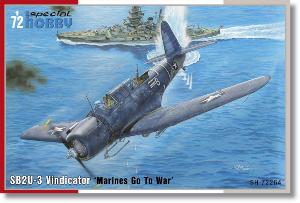
De un vistazo – Quick look
MATERIAL Y PIEZAS
MEDIA & PARTS:
- Plástico inyectado (83 piezas), plástico transparente (3 piezas), resina (2 piezas).
- Injected plastic (83 parts), clear plastic (3 parts), resin (2 parts).
CALCAS – DECALS:
- Insignias norteamericanas de dos tipos, marcas del fuselaje, cola y hélice, líneas de pisado y algunos estarcidos. Aspecto fino y brillante. Buen registro y saturación de color. Soporte ajustado a los motivos.
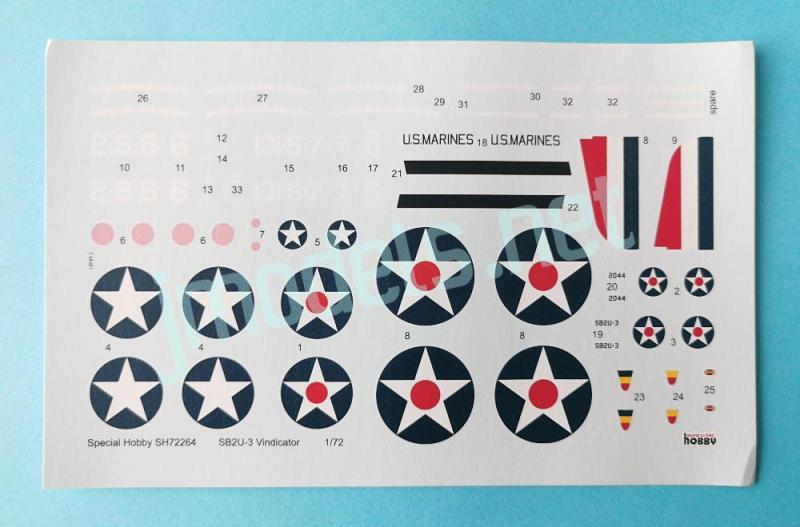
- Two types of US roundels, fuselage, tail and propeller markings, wing walk lines and some stencils. Thin and glossy finish. Good register and color saturation. Carrier film cut close to the decals.
OPCIONES – OPTIONS:
- SB2U-3 Vindicator. N.º de Serie 2045. Marine Scout Bombing Squadron 241 (VMSB-241). Isla Midway, 4 de junio de 1942.
- SB2U-3 Vindicator. N.º de Serie 2044. Diciembre de 1940. Primer avión de serie.
- SB2U-3 Vindicator. N.º de Serie 2050. Marine Scouting Squadron 2 (VMS-2). Base Aérea de los Marines. Ewa, Oahu (Hawái), 7 de diciembre de 1941.
- SB2U-3 Vindicator. N.º de Serie 2082. Marine Scout Bombing Squadron 131 (VMSB-131). Camp Mitchel. New Bern (Carolina del Norte). Agosto de 1941.
- SB2U-3 Vindicator. BuNo. 2045. Marine Scout Bombing Squadron 241 (VMSB-241). Midway Island, 4 June 1942.
- SB2U-3 Vindicator. BuNo. 2044. December 1940. First production aircraft.
- SB2U-3 Vindicator. BuNo. 2050. Marine Scouting Squadron 2 (VMS-2). Ewa Marine Air Station. Ewa, Oahu (Hawaii), 7 December 1941.
INSTRUCCIONES – INSTRUCTIONS:
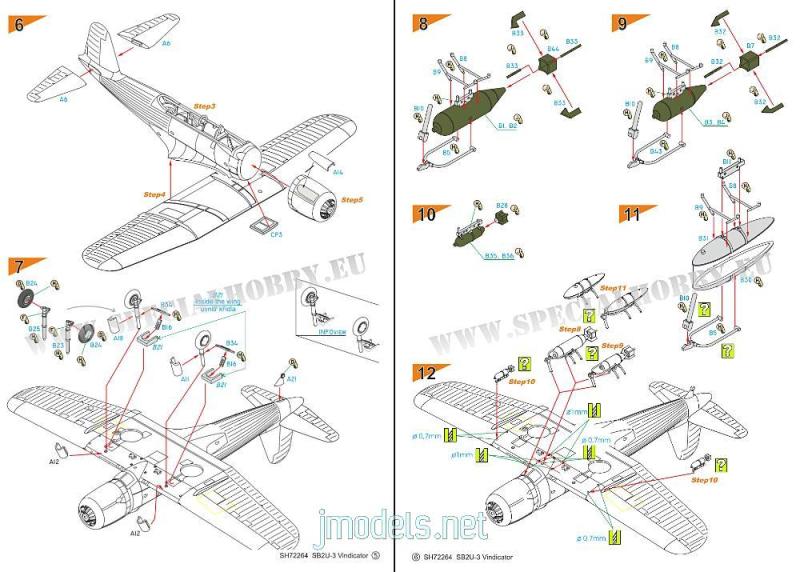
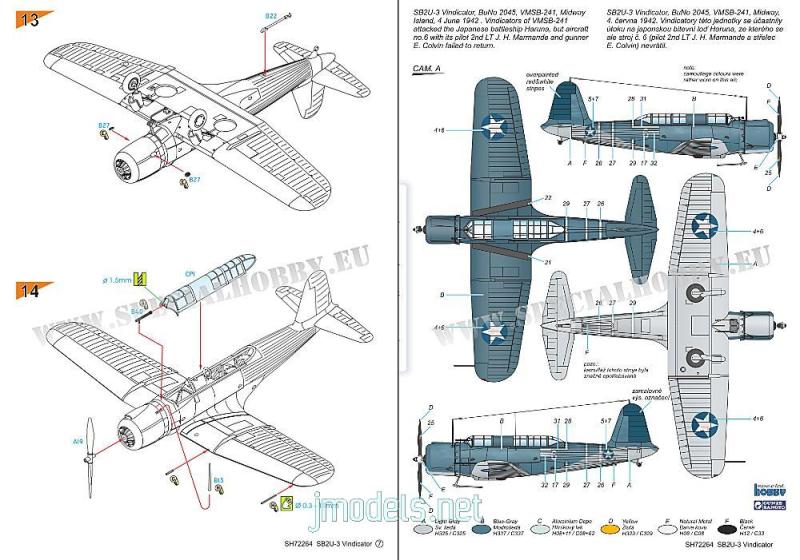
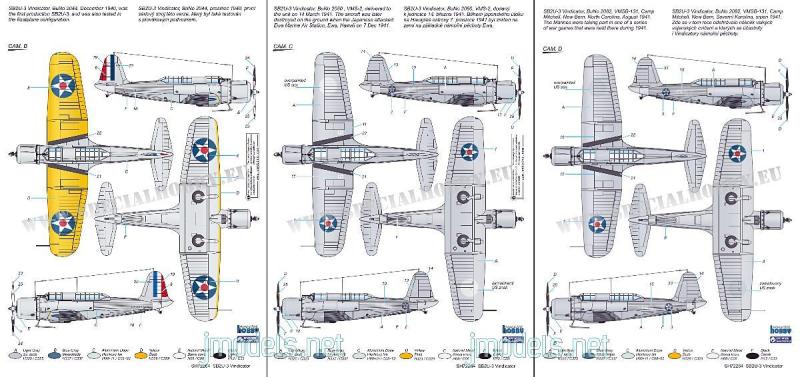
- Libreto de formato A5 de 12 páginas impreso en color. Contiene una introducción histórica con datos técnicos sobre el avión, un plano numerado de piezas, 14 capítulos de montaje y 4 páginas de perfiles con referencias de pintura de Gunze Sangyo.
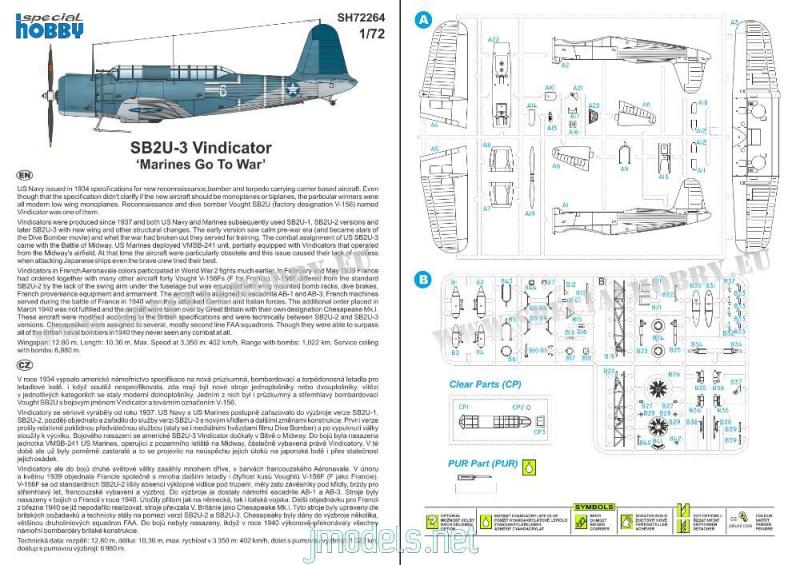
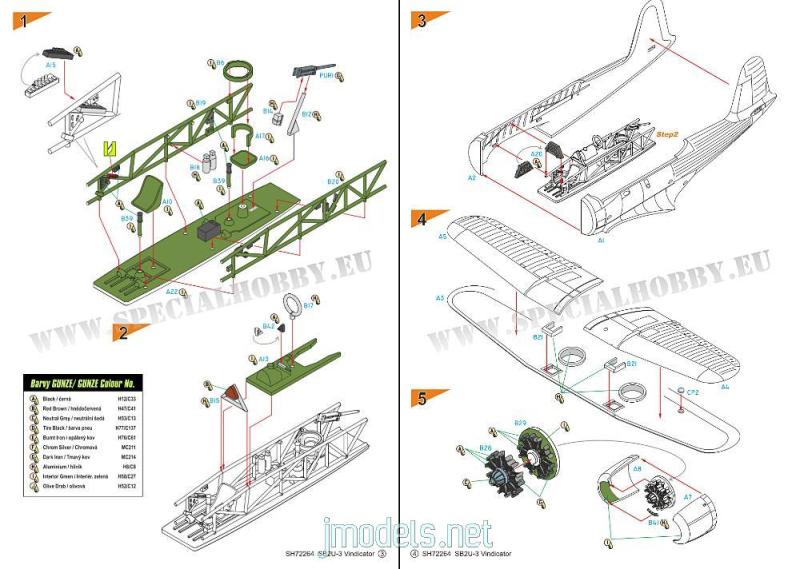
- 12-page A5 booklet printed in color. It shows a historical and technical introduction about the aircraft, a numbered parts diagram, 14 assembly chapters and 4 pages of profiles with paint references from Gunze Sangyo.
LO MEJOR – THE BEST:
- Buen detalle interno y externo.
- Overall nicely detailed inside and outside.
LO PEOR – THE WORST:
- Marcas en el interior del fuselaje. Cubierta de la carlinga de una pieza.
- Marks on the fuselage sidewalls. One-piece canopy.
VALORACIÓN – CONCLUSION:
- Pese a tratarse de una maqueta de serie limitada, parece bastante factible para el modelista de medianas destrezas y experiencia. Incluye acabados variados e interesantes.
- Though still a short-run kit, it looks quite suitable for the modeler with standard skills and experience. Includes a nice selection of varied and interesting paint finishes.

La maqueta
Es una reedición sin cambios del molde de Special Hobby lanzado en 2013. Esta maqueta no es del todo novedosa en este blog, porque hace años escribí sobre el V-156F-3 Vindicator de Azur (referencia A113), que es una copia de este molde con algunos cambios en las piezas de resina, las calcas y parcialmente en las instrucciones.
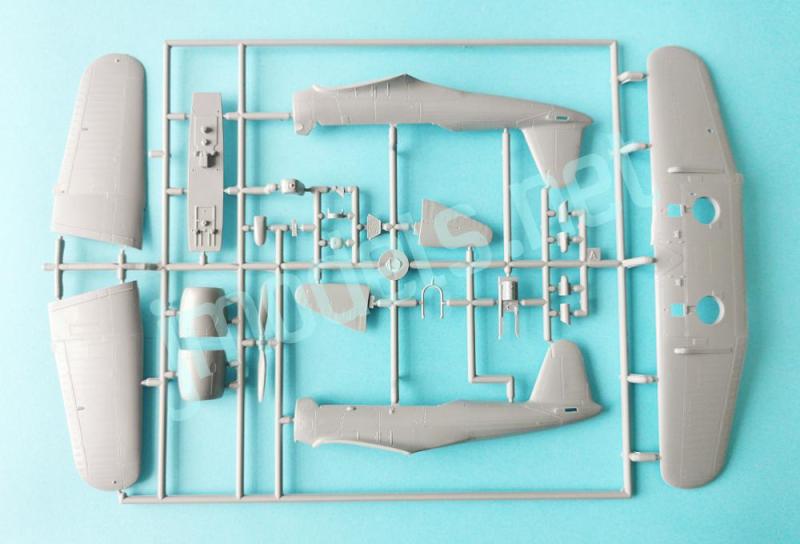
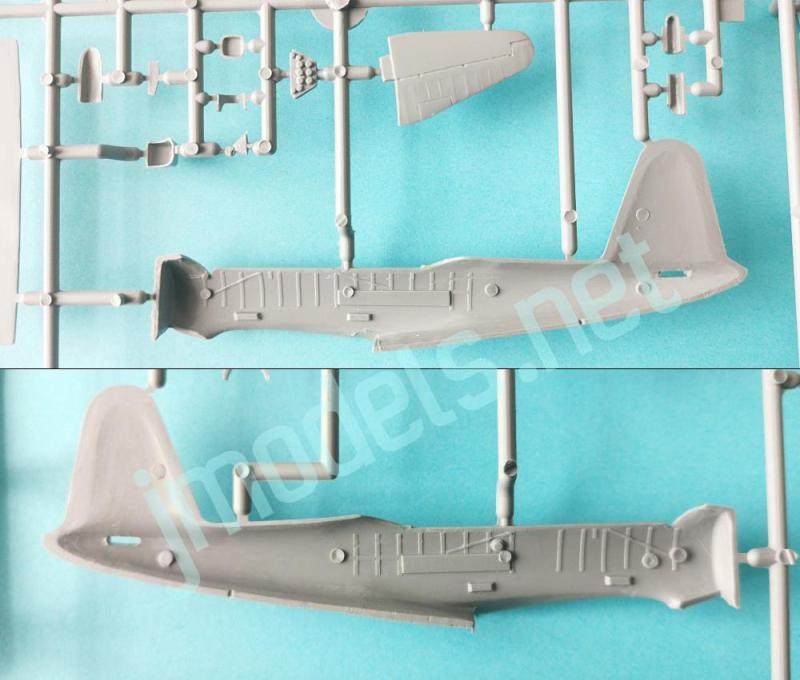
Dentro de la caja encontramos dos bastidores de piezas grises, un bastidor transparente, un pequeño bebedero con dos piezas de resina, la hoja de calcas y las instrucciones. El moldeado es bastante fino y limpio, sin imperfecciones en el molde. Hay varios cilindros de salida del eyector que limpiar con delicadeza en piezas muy finas y frágiles. Desgraciadamente, hay un par de marcas de eyector positivas a cada lado de la carlinga que afectan al detalle moldeado sobre las superficies, pero es posible disimularlas gracias a la estructura tubular separada que las cubre parcialmente.
La estructura del avión está bien reproducida en los paneles grabados y también en el suave relieve de la parte trasera del fuselaje y en las alas. Algunas zonas presentan un remachado fino y realista.
El montaje, que cuenta con muy pocas piezas de resina y ninguna de fotograbado, no debería ser muy complejo para el modelista de nivel medio. Las alternativas de construcción se circunsciben a la carga subalar, que describiré más tarde.
Reseña
La reproducción de la carlinga posee muy buen aspecto general y claramente sólo faltan los arneses de los tripulantes para completarla. Los lados internos del fuselaje muestran una parte de la estructura en relieve y además están complementados por dos piezas que contienen una estructura tubular con varios instrumentos.
El suelo es común para ambos puestos y contiene los pedales y las bases de los asientos. La cabina de pilotaje cuenta con un asiento, una palanca, el reposacabezas y un panel de instrumentos con ambas caras bien definidas. Incluso se le podría añadir el cableado de los indicadores en la parte posterior. La zona intermedia de la carlinga está cubierta por un panel que contiene la antena del radiogoniómetro y el depósito del sistema hidráulico. El puesto trasero incluye dos botellas de aire comprimido, el asiento con doble anillo giratorio, más una ametralladora de resina en posición estibada con su pedestal y caja de munición.
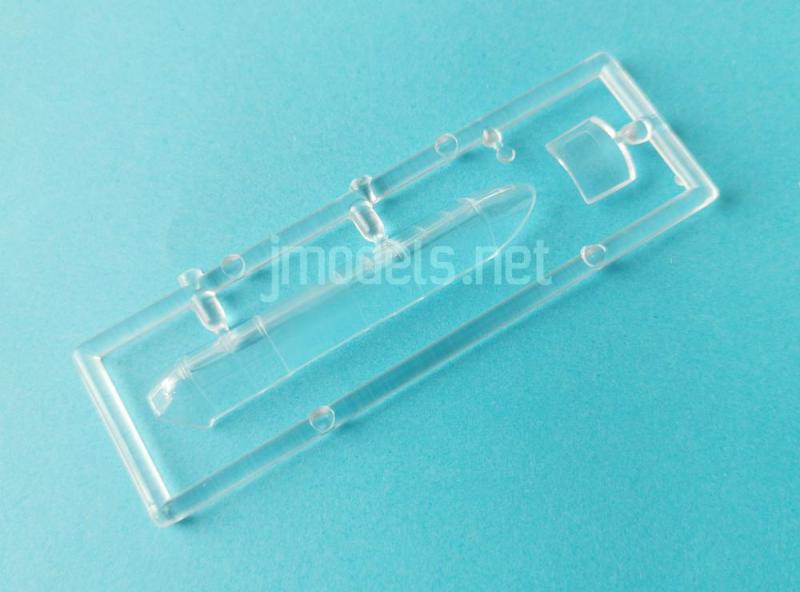
La cubierta de la carlinga es fina, muy transparente y posee la estructura bien representada. Lástima que es de una pìeza y no se pueda mostrar el interior. Además, el parabrisas no está abierto para poder colocar la mira, de forma que esta pieza no queda muy realista.
Las mitades del fuselaje tiene un detalle excelente que consiste en líneas de paneles finas y remachadas en la parte delantera más unas superficies traseras que plasman el relieve estructural de la cola. Los reposapiés de acceso están bien grabados en los dos lados. Bajo el puro de cola tenemos la rueda auxiliar de una pieza y el gancho de apontaje, que en este caso es de plástico y no tiene alternativa de resina como en la maqueta de Azur.
El capó viene separado en mitades con las aletas cerradas. Está detallado con la toma de refrigeración del aceite separada en la parte superior y otra muy pequeña situada en la parte inferior del anillo externo, el mástil de la antena y dos escapes muy cortos, pero detallados en las salidas. El motor está formado por dos coronas de cilindros, la interna moldeada sobre un panel que tapa el hueco del fuselaje. Las piezas tiene un detalle limpio y nítido. La hélice es bastante fina y sus palas están bien perfiladas. La hoja de calcas contiene los logotipos del fabricante para las palas y los colores de las puntas de una de las opciones de pintura.
Las alas constan de dos mitades superiores y una inferior. El diedro parece correcto y las superficies están notablemente detalladas con paneles remachados y el relieve de la estructura interna de las alas y alerones. Los pozos de las ruedas muestran profundidad suficiente y su fondo está detallado. Las superficies superiores muestran las luces de formación y las bisagras de los alerones bien definidas, sin embargo no hay luces de navegación en las puntas de las alas. La luz de aterrizaje bajo el ala de babor es una pieza transparente. El tubo Pitot debe fabricarlo el modelista y parece que también un pequeño tubo que simula la ametralladora fija del ala izquierda, pero debe tratarse de un error de las instrucciones porque el arma no era visible fuera de la tronera.
Las superficies de cola tienen los timones y aletas bien grabados y la reproducción de la estructura es también suave pero bien definida. La luz de navegación de cola está ausente, tal vez por su tamaño diminuto. Los estabilizadores se unen al fuselaje mediante lengüetas y hacen su encastre más sencillo.
Para la carga subalar tenemos varias opciones. Bajo las alas podemos instalar dos bombas de 250 libras unidas a sus soportes. Debajo del fuselaje tenemos un depósito auxiliar que podemos colocar o no en el soporte del sistema de lanzamiento de bombas, o bien dos bombas de diferente tamaño con las aletas y los brazos de sujeción aparte. La sistema de lanzamiento consta de un soporte vertical y una fina horquilla separada.
La maqueta proporciona piezas para detallar el pozo del sistema de retracción de las patas, situado por delante de los pozos de las ruedas. Las patas tienen un detalle bastante nítido y llevan las carenas aparte. Las ruedas son de una pieza y me parecen destacables por la reproducción de los neumáticos y llantas.
La hoja de calcas contiene insignias norteamericanas de dos tipos (preguerra e inicios de la Segunda Guerra Mundial), marcas del fuselaje, cola y hélice, líneas de pisado y algunos estarcidos. Su aspecto es fino y brillante, tiene buen registro y saturación de color y el soporte apenas sobresale de cada calca.
El manual de instrucciones posee un formato A5 y consta de doce páginas impresas en color. Contiene una introducción histórica con datos técnicos sobre el avión, un plano numerado de piezas, 14 capítulos de montaje y cuatro páginas de perfiles con referencias de pintura de Gunze Sangyo.
La selección de acabados me parece variada e interesante. Así, tenemos un avión con librea gris azulada sobre gris claro derribado en el ataque al acorazado japonés Haruna durante la Batalla de Midway. Las insignias nacionales de este avión llevan el círculo rojo central en una calca separada, de este modo salvamos la dificultad de tener que reproducirlo casi borrado por un repinte posterior. Otras alternativas son el primer SB2U-3 de serie, que también fue probado con flotadores, como atestiguan varias imágenes de época, y que estaba pintado de gris claro con alas amarillas por arriba, y dos aviones con librea gris clara, ambos con una de las insignias de las alas suprimida, pero distinguible por su marca.
Valoración
Sin dejar de ser una edición limitada, la maqueta tiene una dificultad apta para modelistas de habilidad media, y esto no se puede decir de todas las de esta clase. El detalle externo me parece muy bueno, pero es una lástima que el modelo no pueda mostrar todo lo que lleva dentro de la carlinga debido a la cubierta de una pieza. Con todo, para los seguidores de la aviación naval, especialmente de la norteamericana, las versiones de los Marines resultan interesantes por la variedad de libreas en un periodo que abarca desde la inmediata preguerra hasta 1942 y seguramente sabrán aprovecharlo.◊

The kit
This is a reissue of Special Hobby’s tool launched in 2013. This kit isn’t entirely new to this blog, as I wrote about the Azur V-156F-3 Vindicator (reference A113) years ago, which is also a copy of this mold with some changes to the resin parts, decals, and partially to the instructions.
Inside the box we find two sprues of gray parts, a clear sprue, a small gate with two resin parts, the decal sheet, and the instructions. The molding is quite fine and clean, with no blemishes. There are several ejector nodules that need careful cleaning on very thin and fragile parts. Unfortunately, there are a couple of positive ejector marks on each cockpit side that affect the detail molded on the surfaces, but these can be concealed thanks to the separate tubular structure that partially covers them.
The aircraft’s structure is well reproduced in the engraved panels and also in the smooth raised detail on the rear fuselage and wings. Some areas feature fine, realistic riveting.
Assembly, which needs very few resin parts and no photo-etched pieces, shouldn’t be too difficult for the average modeler. The only construction options are the underwing load, which I will describe later.
Review
The cockpit is very well stuffed overall, with only the seat belts missing to round it off. The fuselage sidewalls are molded with some raised structural detail and there are two separate pieces containing a tubular structure with various instruments.
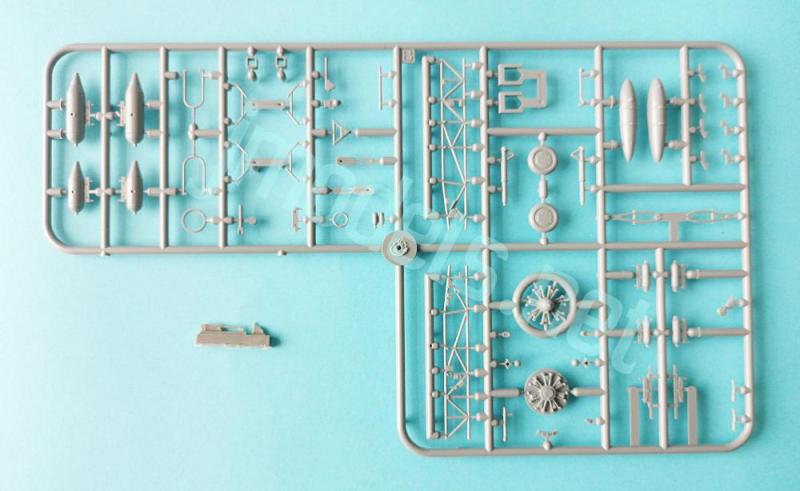
The floor is common to both seats and contains the pedals and seat bases. The pilot’s cockpit has a seat, a control stick, a headrest, and an instrument panel with both sides clearly defined. The wiring for the indicators could even be added to the rear. The middle cockpit section is covered by a panel containing the radio loop antenna and the hydraulic system tank. The rear position includes two compressed air bottles, a swivelling seat with a double ring, plus a resin machine gun in stowed position with the stand and ammo box.
The cockpit canopy is thin, very transparent, and has a nice raised structure. Unfortunately, it’s a single piece and all the cockpit detail cannot be shown. Also, the windshield is not open to allow for the placement of the gunsight, so this panel doesn’t look very realistic.
The fuselage halves have excellent detail, consisting of a mixture of fine, riveted panel lines at the front and rear surfaces rendering the tail structure. The entry steps are engraved on both sides. Under the tail boom, we find the one-piece tailwheel and the arresting hook, which in this case is made of plastic and doesn’t have a resin alternative as in the Azur kit.
The cowling comes split in halves with the gills molded closed. It is detailed with a separate oil cooler intake at the top and the small carburettor intake on the forward ring, the antenna mast and two very short exhausts. The engine is made up of two cylinder rows, the inner one molded on a panel that covers the fuselage gap. The pieces have clean and crisp detail. The propeller is quite thin and the blades are well profiled. The decal sheet contains the manufacturer’s logos for the blades and the tip color stripes for one of the paint options.
The wings consist of two upper and one lower halves. The dihedral and wing hinge lines look fine and the surfaces are remarkably detailed with riveted panels and the internal structure of the wings and ailerons. The wheel wells are deep and the bottom is not empty of some detail. The formation lights and aileron hinges are clearly visible on the upper surfaces, but the wingtip navigation lights are missing. The landing light under the port wing is a clear piece. The pitot tube is provided by the modeler and a small tube that seems the fixed machine gun barrel is attached to the left leading edge. This must be a mistake in the instructions because the barrel was not visible.
The tail surfaces have finely engraved rudders and fins and the rendition of the structure is also smooth but well defined. The tail navigation light is absent, perhaps because of its tiny size. The stabilizers are attached to the fuselage with tabs and this makes assembly easier.
The underwing load has several options. Under the wings we can install two 250lb bombs molded with their pylons. Under the fuselage we have an auxiliary tank that we can place or not on the bomb release gear, or a choice for two bombs of different sizes with the separate fins and shackles. The release gear consists of a vertical piece and a separate thin fork.
The kit includes parts for detailing the landing gear housing forward of the wheel wells. The landing gear is nicely detailed and includes separate leg fairings. The wheels are one-piece with the tires and rims well defined.
The decal sheet shows two types of American roundels (prewar and early World War II), fuselage, tail, and propeller markings, wing walk lines, and some stencils. They have a fine, glossy finish, good register and color saturation, and the carrier film is cut close to each decal.
The instruction manual is A5 format and consists of twelve pages printed in color. It contains a historical introduction with technical data about the aircraft, a numbered parts diagram, 14 assembly chapters, and four pages of profiles with Gunze Sangyo paint references.
I find the choice of finishes varied and interesting. First, we have an aircraft with a bluish-gray livery over light gray, which was shot down in the attack on the Japanese battleship Haruna during the Battle of Midway. The national markings on this aircraft feature the central red circle on a separate decal, thus avoiding the difficulty of reproducing it almost blurred by a later repaint. Other alternatives include the first production SB2U-3, which was also tested with floats, as evidenced by several period photographs, and which was painted light gray with yellow upper wing surfaces, and two aircraft with an overall light gray livery, both with one of the wing roundels painted over, but still evident under the paint coat.
Conclusion
While still a limited run, the SH kit looks suitable for modelers of intermediate skill, which isn’t usually the case with all kits of this type. External detail is excellent, but it’s a shame the one-piece canopy prevents from fully appreciating the cockpit’s interior. However, for fans of naval aviation, and especially US Navy aircraft, the Marines versions are interesting, covering a variety of liveries across the period from the pre-war era to 1942, and they will surely find it attractive.◊
Publicado – Published: 8 / 2026
©www.jmodels.net


Debe estar conectado para enviar un comentario.